

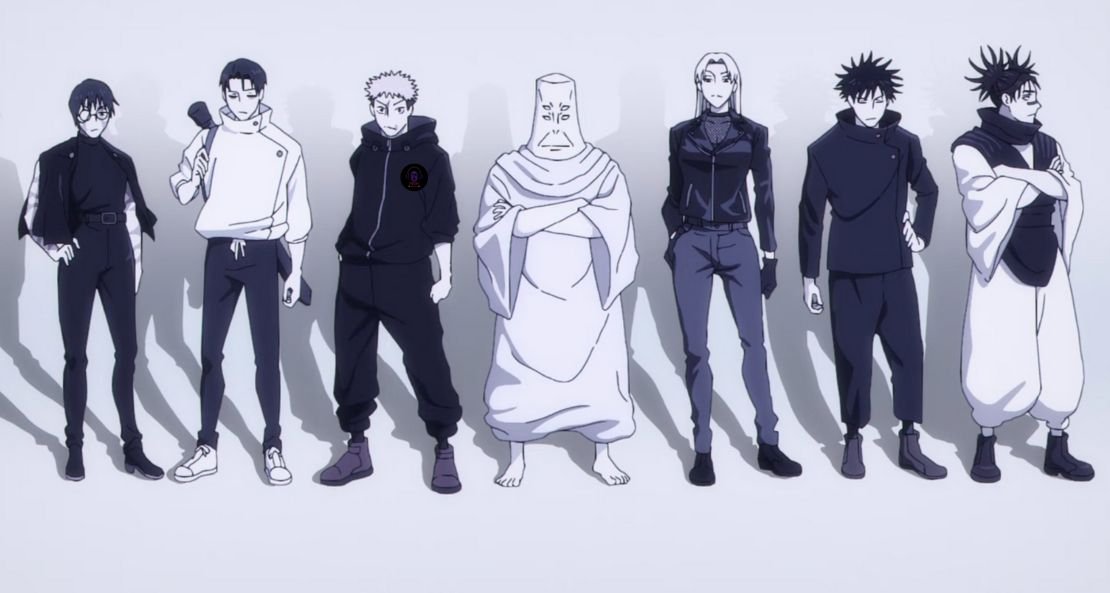
King Gnu’s latest opening for Jujutsu Kaisen doesn’t ease you in. “AIZO” arrives mid-impact, loud and unstable, the kind of track that feels like it’s already halfway through its own breakdown.
It’s the band’s third collaboration with the series, but it doesn’t behave like a victory lap. If anything, it sounds restless, impatient, almost over-stimulated, which makes it a fitting match for the Culling Game arc.
The song moves in a frenetic pattern. Guitars grind against candy-bright hooks, chants cut in and vanish, and the tempo keeps slipping sideways just as you think you’ve got a grip on it.
There’s metal weight, pop gloss, and flashes of something closer to hyperpop chaos, all stitched together without smoothing the edges.
In an anime landscape where openings often commit to a single mood, “AIZO” thrives on whiplash.That instability carries into the visuals, which fans immediately latched onto.
Viewers spotted distorted nods to classical art, from echoes of The Scream to a Klimt-like embrace, folded into an opening that floods the screen with colour and movement. Kenjaku’s role stood out most.
Rather than framing him as a looming mastermind, the opening casts him as an observer, placing barriers like toys or peering through them like a microscope.
The Culling Game isn’t presented as a noble battle or a tragic war. It’s a spectacle, something arranged, monitored, and enjoyed from a distance.
That idea cuts straight through the brightness, turning the chaos sour the longer you sit with it.
Daiki Tsuneta has described “AIZO” as an update on King Gnu’s established sound, and that intention shows in how aggressively the track mutates.
You might also like:
- Top 10 Best Anime of 2025 (So Far) — UK Watch Guide
- Top Anime Theme Songs – A Journey Across Decades
- Top 10 Best Anime of 2025 (So Far) — UK Watch Guide
- Beautiful Colors Lyrics Meaning: OneRepublic’s Emotional Anime Song for Kaiju No. 8
- Japan’s Spotify Charts: When Domestic Music Still Wins
The opening chants of “Love me! Hate me! Kill me!” feel less like a hook and more like a warning.
Around the midpoint, the song briefly pulls back, creating a false sense of control, before surging forward again with even more urgency. It never fully resolves. It just keeps moving.
Lyrically, Tokyo becomes a pressure system rather than a setting. Lines about love and hate colliding, about surviving while soaked in shame, mirror the arc’s central tension.
Staying alive isn’t framed as heroic. It’s awkward, humiliating, and exhausting.
Even moments of softness feel conditional, something that has to be processed, filtered, justified. Mercy exists, but it’s scarce, and it doesn’t come without cost.
The chorus leans into that fatalism. “Drifting apart in the end, that’s how it goes” isn’t resignation so much as acceptance.
The promise to meet again someday feels fragile, almost procedural, like something characters tell themselves because the alternative is too bleak to sit with. It fits an arc built on temporary alliances and inevitable separation.
Compared to King Gnu’s earlier Jujutsu Kaisen work, especially “Specialz,” “AIZO” is less immediately iconic and more abrasive by design.
It doesn’t aim for instant catharsis. It mirrors the Culling Game’s pacing instead: too much information, too many players, no clear moral centre.
That choice won’t land for everyone, and it’s already split opinion, but it feels intentional rather than cautious.
“AIZO” released digitally on January 9, with a physical CD following on February 11, and serves as the opening theme for Jujutsu Kaisen Season 3: Culling Game Arc – Part 1, which premiered January 8.
Tsuneta has spoken about approaching the arc as a viewer first, and that perspective comes through. The song doesn’t explain the chaos. It drops you inside it and lets the noise do the work.
This opening doesn’t try to convince you it’s important. It overwhelms you, distracts you, and keeps moving.
If this is the kind of music and anime crossover you want more of, subscribe to Neon Music for deeper coverage without the noise.
For a story built around spectacle, cruelty, and systems that treat people as pieces, that might be the most honest approach King Gnu could have taken.